
Orbital Gate
Ground stations a country can own.
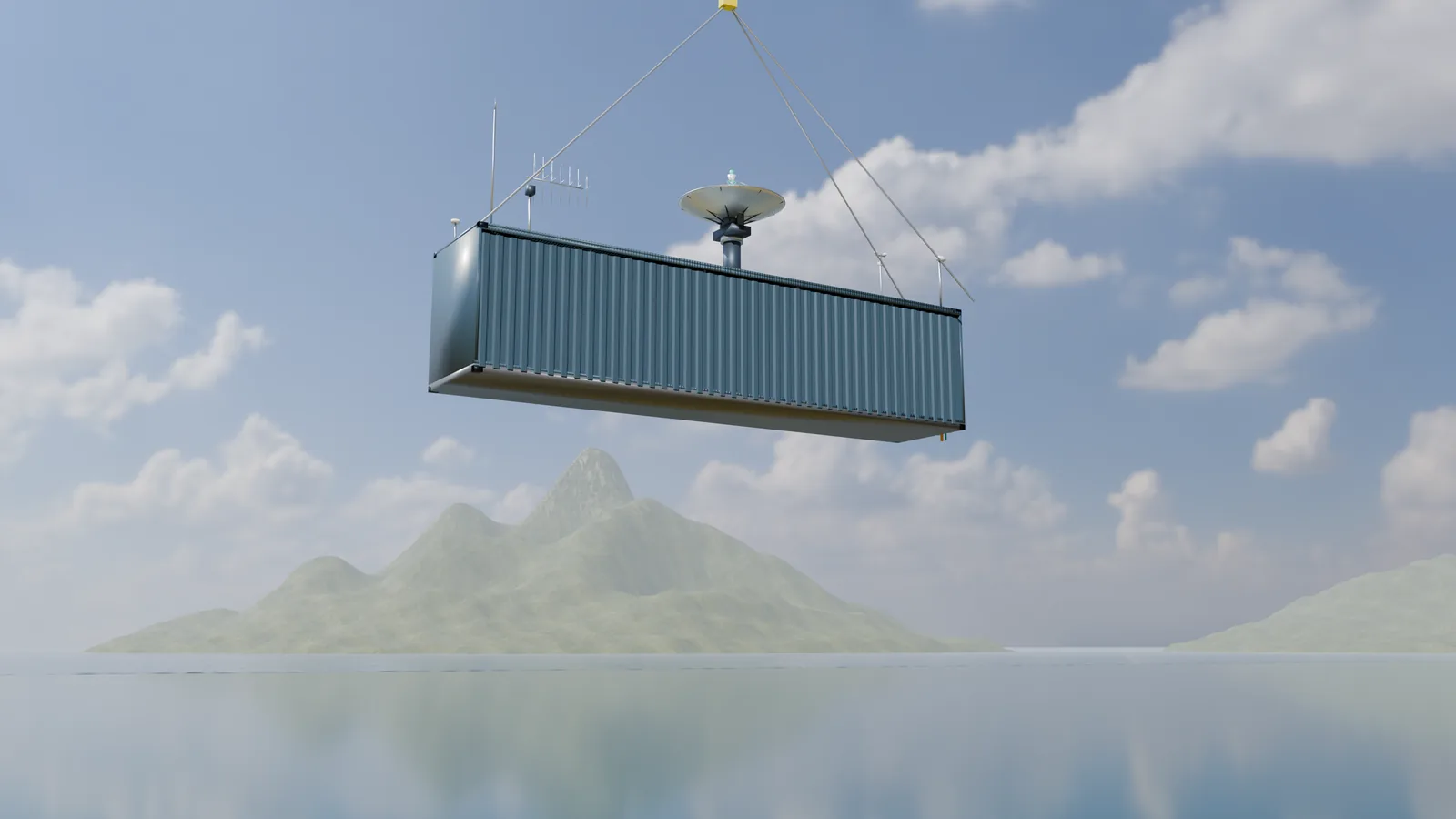
A complete ground station in a shipping container, owned by us or financed to the country, delivered in months. Our software runs every station as one network that any satellite can book.
- $82.7B
- ground station market by 2030Source: MarketsandMarkets, 2025–2030
- $8.0B
- ground station services by 2030Source: Frost & Sullivan
Network OS
The Network OS will run each country's station as part of a regional network
Operators will book time on the stations their licence allows. When one site can't cover a pass, the network will make it a two-station pass across a border. Each owner sets the rules, and each minute carried will be signed and billed.
Scheduler
Will allocate time, beams and spectrum across the network's stations, under each owner's rules.
Two stations, one download
Will build one contact from segments on two stations when neither covers the window alone.
The owner sets the rules
Each station will receive a signed, time-boxed segment. A contact will have one uplink token, and only the station holding it can transmit.
Signed pass record
Each station will sign its segment, and the network will sign the whole contact.
Billing
Owners will be paid for the minutes their station carried, calculated from the signed record.
Data stays where the owner says
Owners will decide who may use a station and which partners it may join in two-station passes. The scheduler checks that policy before it allocates any time.
Backup station
If a station fails, its bookings will move to other stations licensed to carry them. Anything that can't move will be credited.
Gateway hosting
Constellations will be able to lease gateway capacity on the same sites. Leased capacity comes out of the shared pool.
The 4:18 technical walkthrough steps through each of these.
The packages in 1:34
Coverage where stations are scarce
Outside the US, only six countries receive Landsat 8 and 9 directly on their own stations. Stations in small island states and across Africa, owned by us or financed to the country, will add coverage where stations are scarce and keep each country's data in the country, with booking, metering and billing on the same network.
Sovereignty
Who owns the ground, and who it serves
| Question | Starlink gateway | Orbital Gate station |
|---|---|---|
| Who owns the ground | SpaceX | Orbital Gate, or financed to the country |
| Who can use it | Starlink only | Every challenger constellation and operator |
| Where data lands | Where SpaceX routes it | In country, under the owner's policy |
| Who operates it | A local network provider | National engineers, with our remote NOC |
| Who pays whom | A local provider pays SpaceX from US$75,000 a month, plus US$1.25 million upfront for the gateway antennas | Operators will pay for the minutes they book, and the owner will receive a share of each minute its station carries |
Starlink: DCD; Via Satellite, Starlink Community Gateway pricing, 17 January 2024.
Licensing
Four ways onto the network
The network will earn on each antenna connected to it, including antennas Orbital Gate didn't build.
Network licence
Per antenna
For universities, agencies, teleports and other operators: bring an existing antenna onto the network.
Sovereign licence
Per country
For governments: the Network OS for a national network, with the data kept in the country.
White label
For station builders
Station builders will ship their stations with the Network OS under their own name.
Transaction fee
On third-party bookings
When an operator books a third-party antenna through the network, the antenna owner will pay a fee from the booking.
Prices on request.
Ask for pricingThe station and the software
The country owns the station. We run the network. No one else offers both.
Mobile Ground Station
A complete station in an ISO 40 ft high-cube container. It will ship by sea like any container and set up where it's needed. It will be a national ground station, owned by us or financed to the country. Six configurations, from a single tracking dish to 7.3 m GEO dishes.
Explore the stationNetwork OS
One schedule for all the stations on the network. It will plan time and frequencies across sites, hand a pass from one station to the next, and sync data between them under each owner's policies.
See the softwareWhy a container
It will ship like freight and arrive complete
It will ship like freight
ISO corner castings and a CSC plate, so it will lift, stack and travel by container ship and truck. Dishes, panels and masts fold or come off for transit.
It will arrive complete
Operations, compute, RF, power and cooling will travel inside the container, ready to connect to shore power, data and fibre.
Owned by us or financed to the country
The country will run it on its own terms.
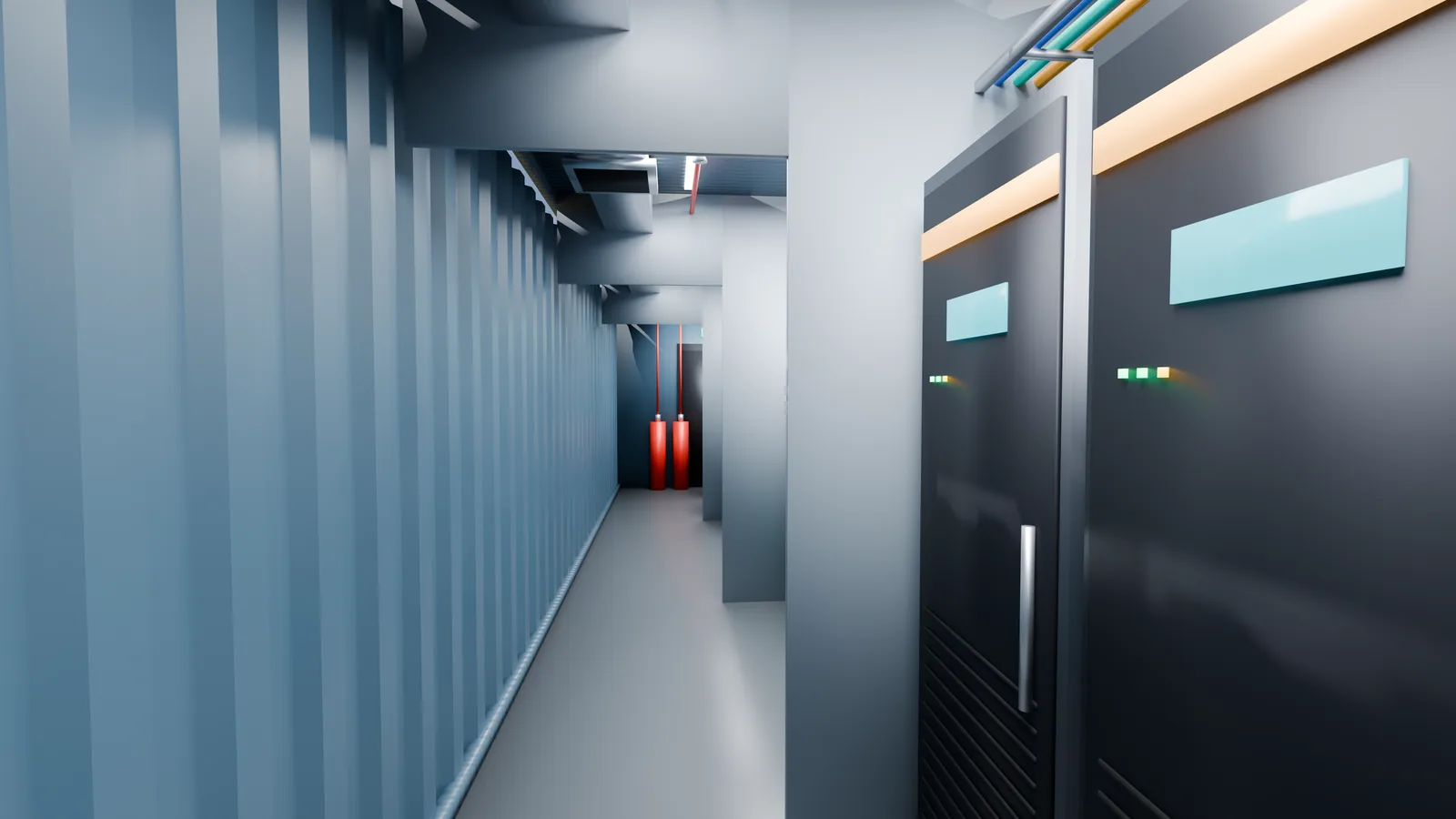
Inside the container
The five bays
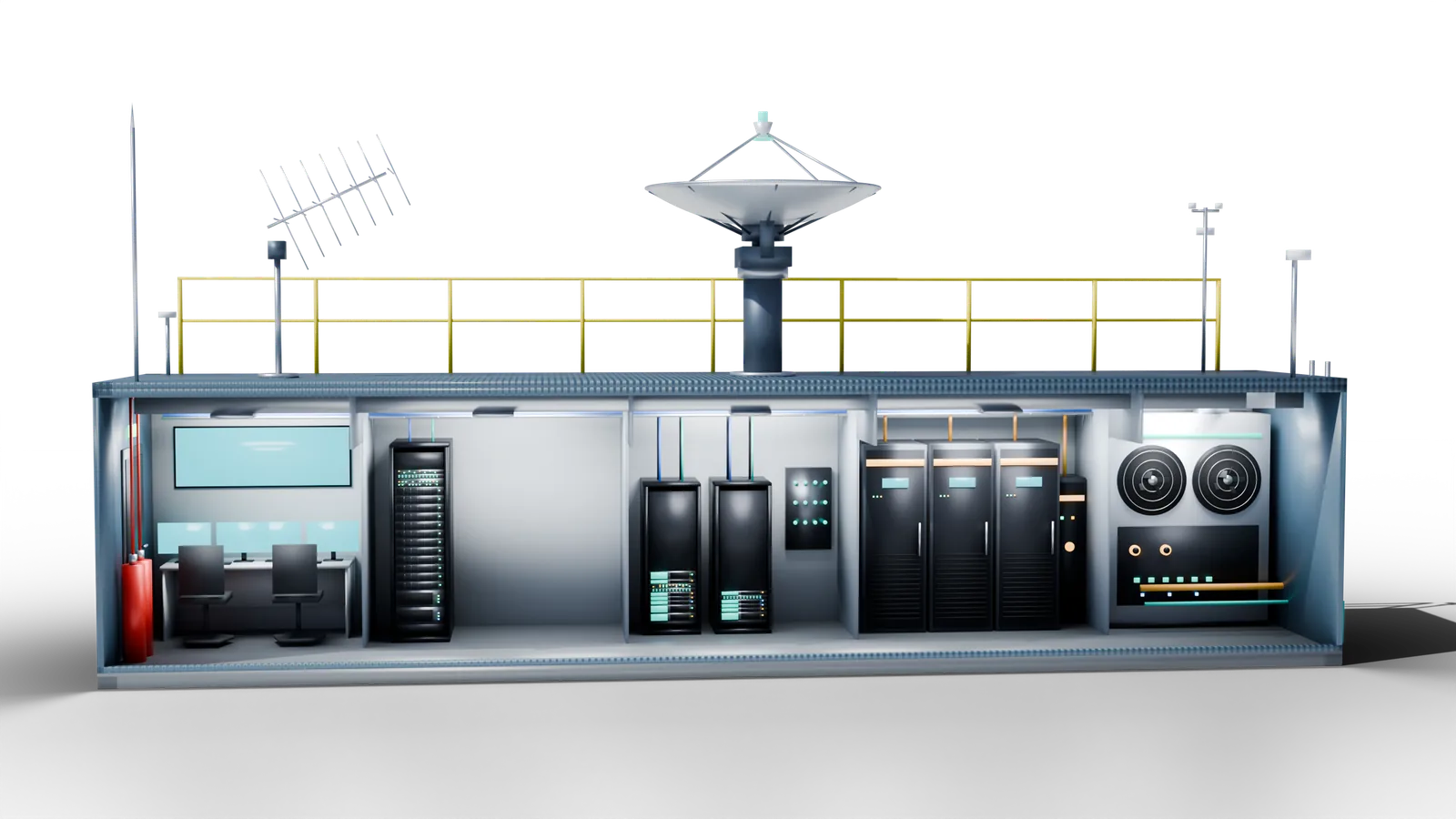
- A
NOC
Operator positions with dual monitors and a video wall.
- B
Compute
A rack of GPU compute, storage, networking and KVM, all front-access.
- C
RF
Software-defined radios and modems, up/down converters, LNA and HPA control, and a GPS-disciplined reference clock.
- D
Power
An LFP battery store behind an automatic transfer switch, so moving between shore or generator power and the batteries never interrupts the load.
- E
HVAC + I/O
Cooling ducted over every bay, and the inlets for shore power, data and fibre.
Configurations
Six configurations
From a single tracking dish for low-earth orbit to ground-mounted dishes for GEO and MEO links.
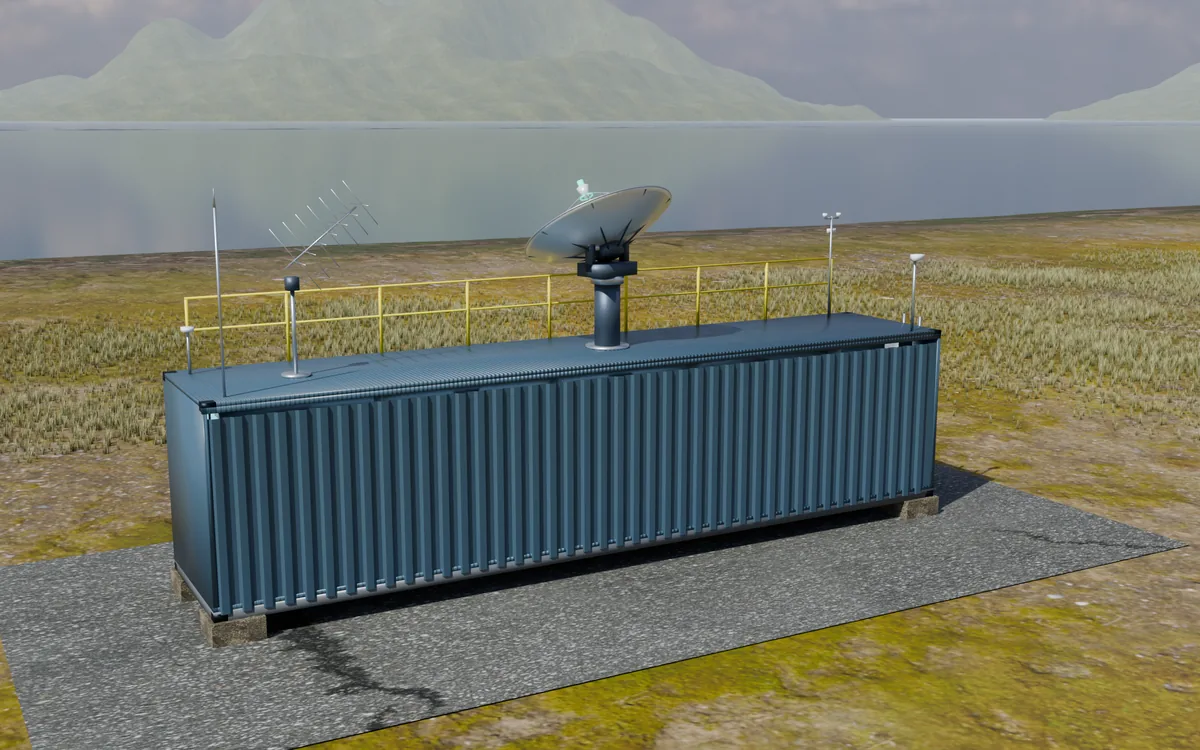
Rendering: single tracking dish First unit
Single tracking dish
2.4 m S/X tracking dish that works one satellite per pass and folds for transit.
- UHF
- S
- X
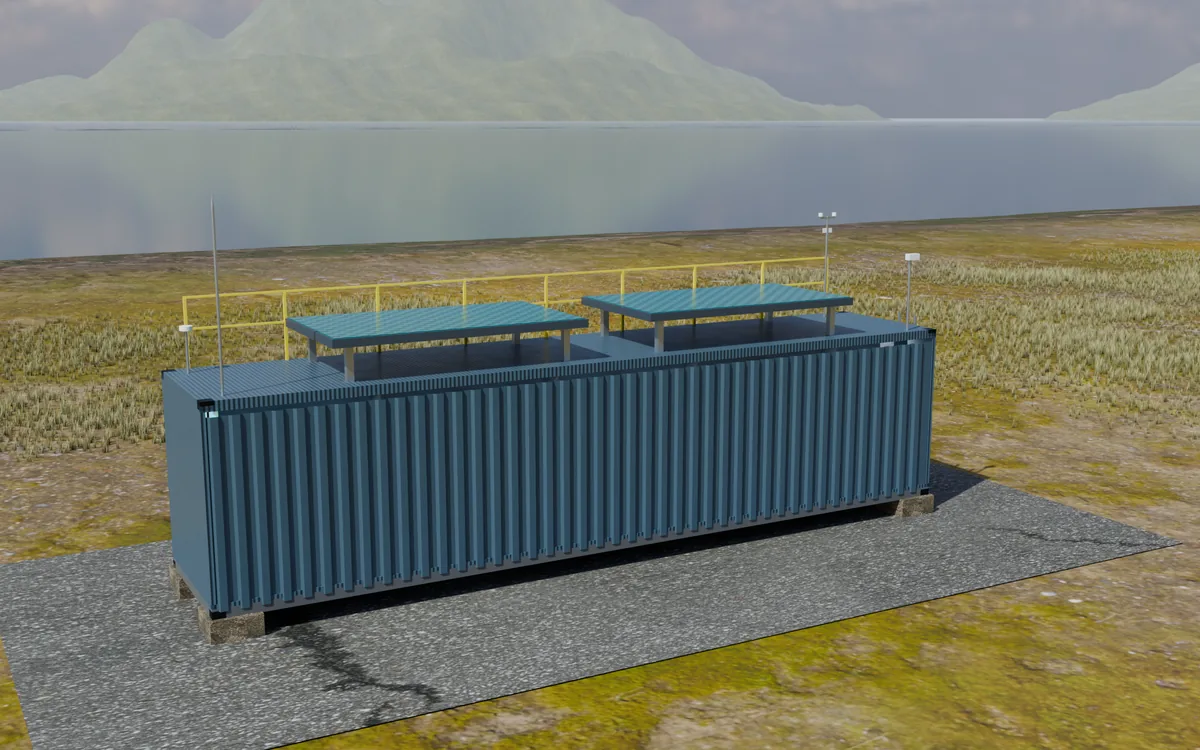
Rendering: phased-array primary aperture Core unit
Phased-array primary aperture
Dual phased-array panels on posts above the roof.
- UHF
- S
- X
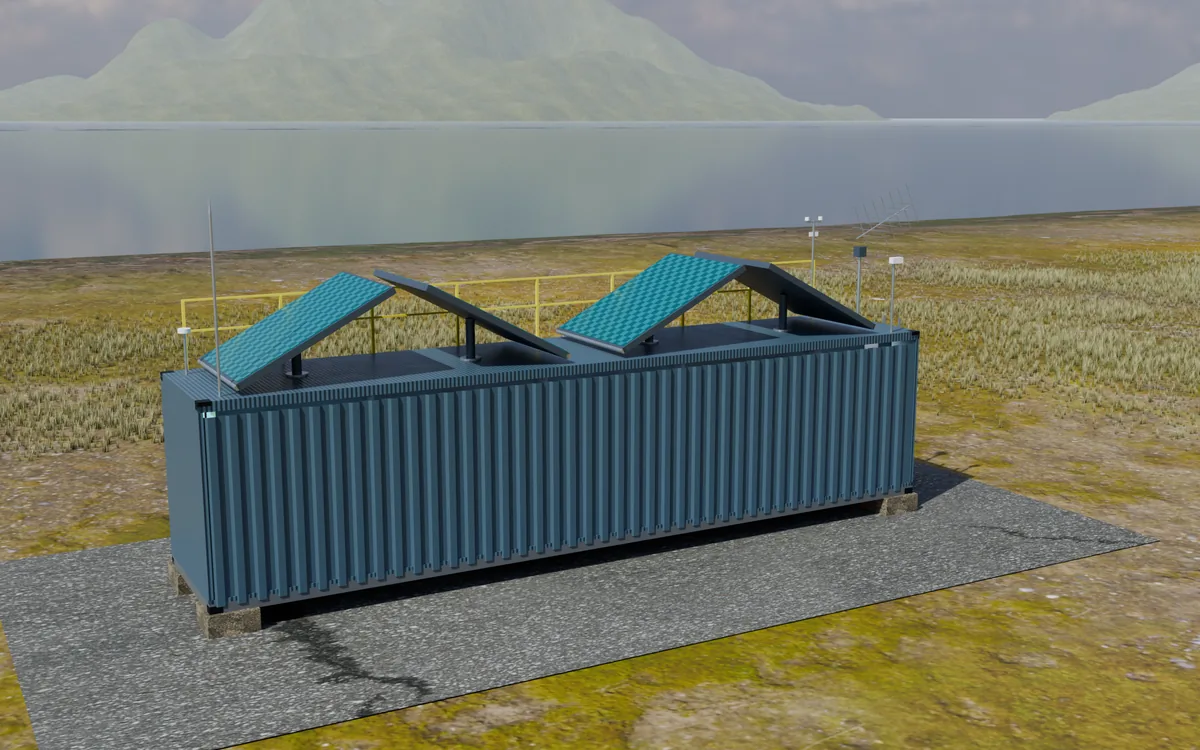
Rendering: multi-beam phased arrays Max satellites
Multi-beam phased arrays
Four S/X phased-array panels tilted north, south, east and west, plus UHF.
- UHF
- S
- X
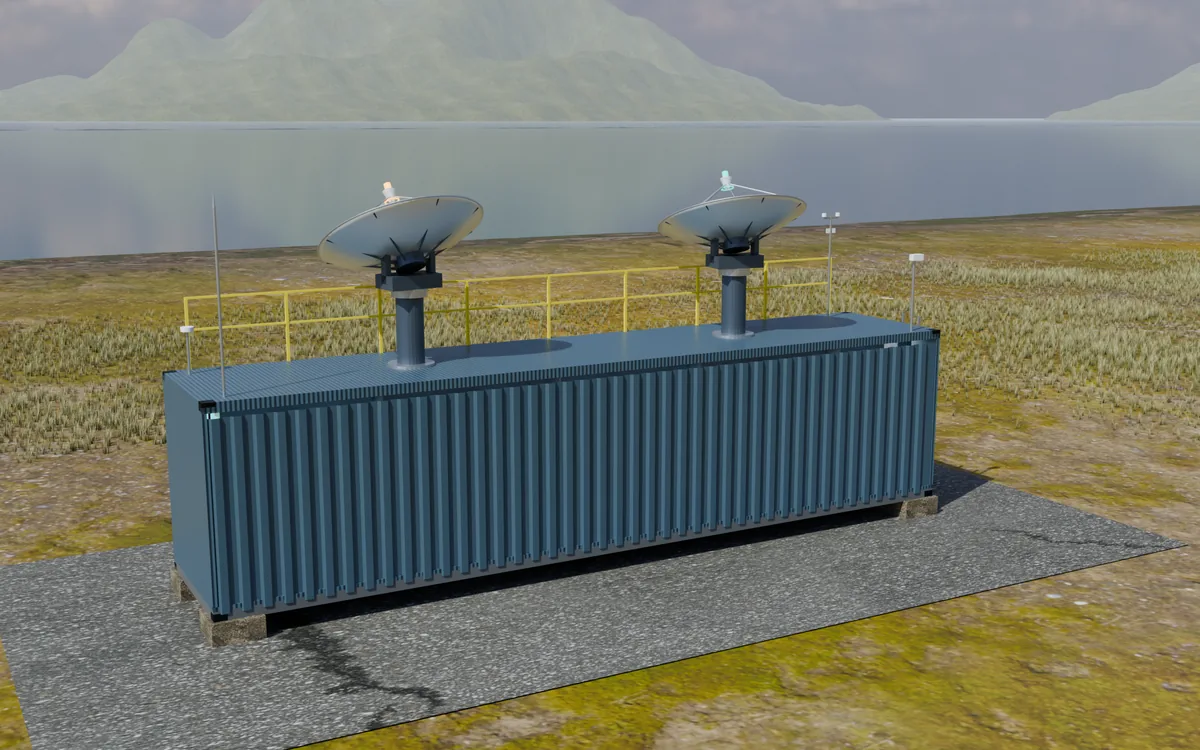
Rendering: Ka + X high-rate dishes Max throughput
Ka + X high-rate dishes
A 2.4 m Ka dish and a 2.4 m S/X dual-polarisation dish.
- S
- X
- Ka
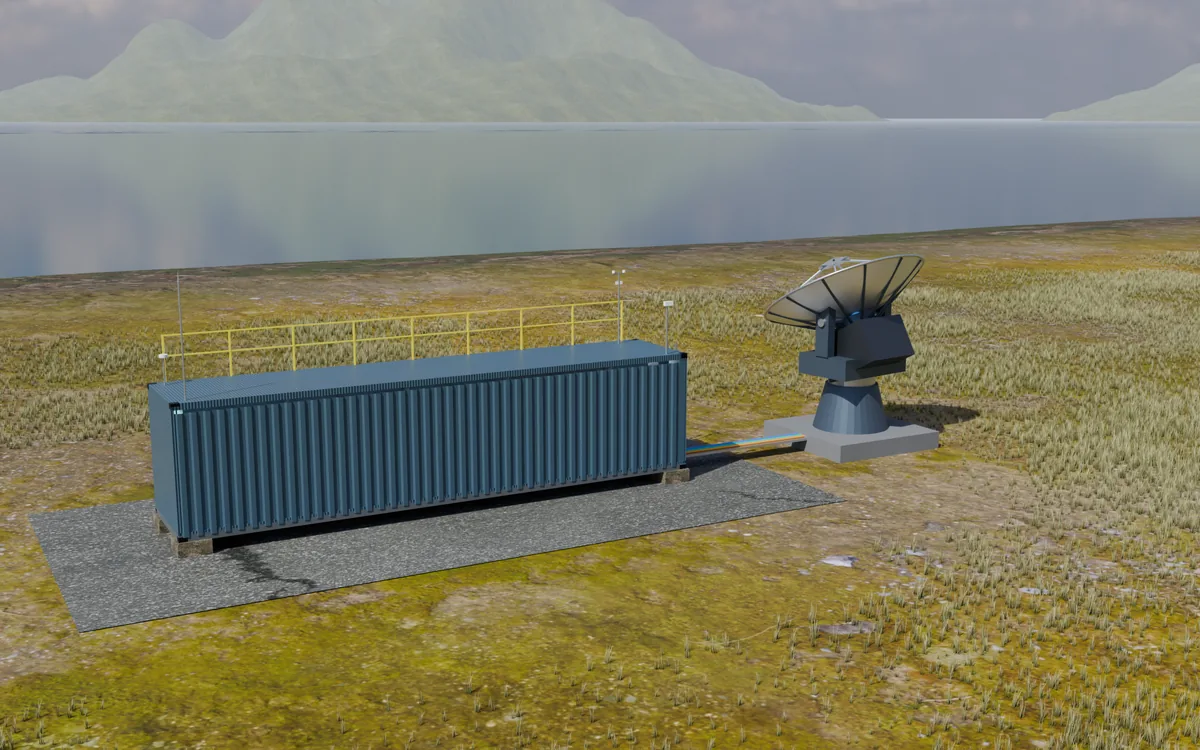
Rendering: 4.5 m ground-mounted dish GEO/MEO · 4.5 m
Ground-mounted dish
4.5 m dish on its own foundation beyond the container end.
- S
- X
- Ku
- Ka
- L rx
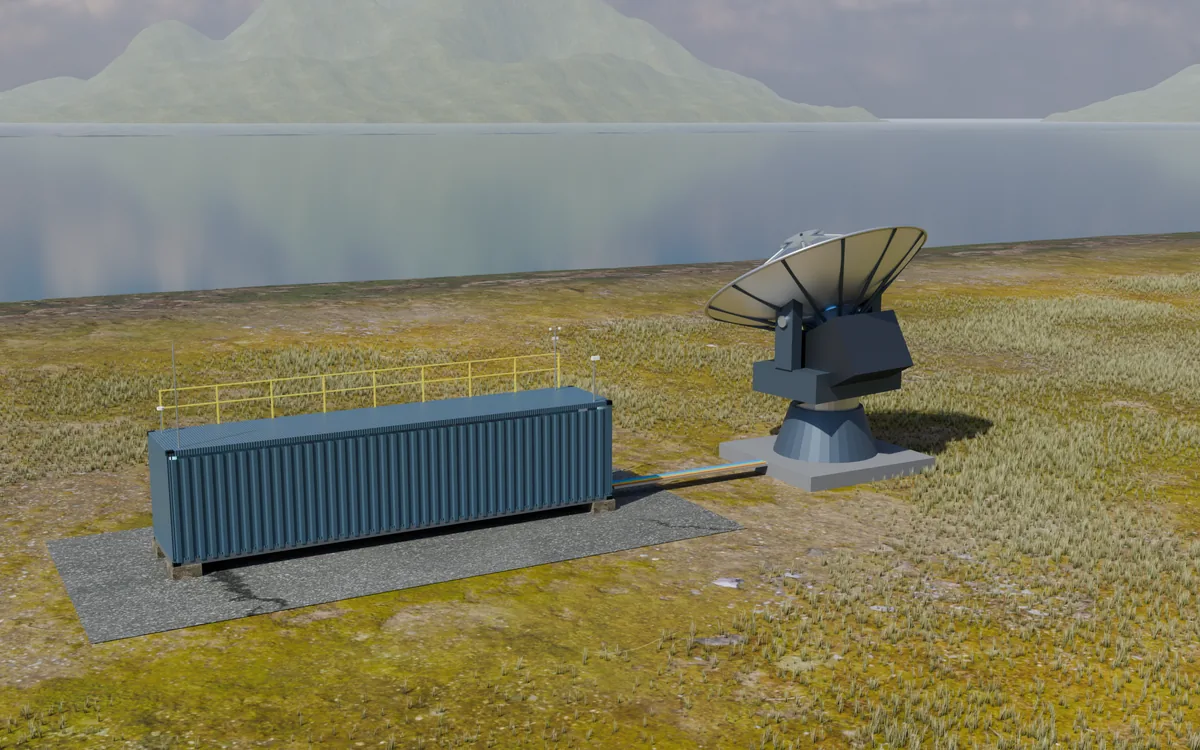
Rendering: 7.3 m ground-mounted dish GEO/MEO · 7.3 m
Ground-mounted dish
7.3 m dish on its own foundation beyond the container end.
- S
- X
- Ku
- Ka
- L rx
Each configuration has a full specification, covering rates, contacts per day, power and reach. Ask for it.
How it works
From booking to delivery
- 01
Schedule
Contacts will be booked across the network's stations, with conflicts resolved before the pass.
- 02
Track
As the satellite rises, the station will point its dish or form a beam with its phased arrays.
- 03
Receive
Software-defined radios at the station will demodulate and decode the link: CCSDS, AX.25, KISS.
- 04
Route
The gateway will authenticate and route the data, and Sync will move it between sites under the owner's policies.
- 05
Deliver
Data will reach the control hub and the operator's own systems.
Who it's for
Buyer · countries and space agencies:
a national ground station, owned by us or financed to the country.
Organisations within a country
Research, telecom and public-service bodies that need satellite data on their own terms.
User · satellite operators and constellations:
book contacts on the stations their licence allows, pay per minute, or lease gateway capacity.
Partner · ground-station operators:
bring existing antennas onto the network under a network licence.
What a station in the country will do with the data, from fisheries patrols to drought warnings: Applications.
Questions
Is it available today?
Orbital Gate is in development. Early-access partners help shape the first units and the software.
Can we see the figures?
Yes, on request. Each configuration has a full specification, and the station designs can be explored in a 3D viewer with an access code.
Who owns the station?
Orbital Gate, or the country when the station is financed to it.
How does it get there?
By container ship and truck, like any 40 ft container. The dishes, panels and masts fold or come off for transit.
Which bands?
It depends on the configuration: UHF/VHF and S/X for TT&C, X and Ka for high-rate downlink, with Ku and L-band receive on the GEO/MEO dishes.
Can our existing stations join?
The software is built for federation: third-party stations join the same schedule.
Ground stations a country can own.
Early-access partners help shape the first units and the software, and get the full specifications.